Obtaining a Roszdravnadzor Registration Certificate for medical devices
Registration of medical devices with Roszdravnadzor is a state procedure that allows medical devices to be lawfully marketed in the Russian Federation. In essence, this is the main legal filter confirming that the product may be placed on the market, supplied, used in public procurement, listed on marketplaces, and applied in clinical practice for its intended purpose.
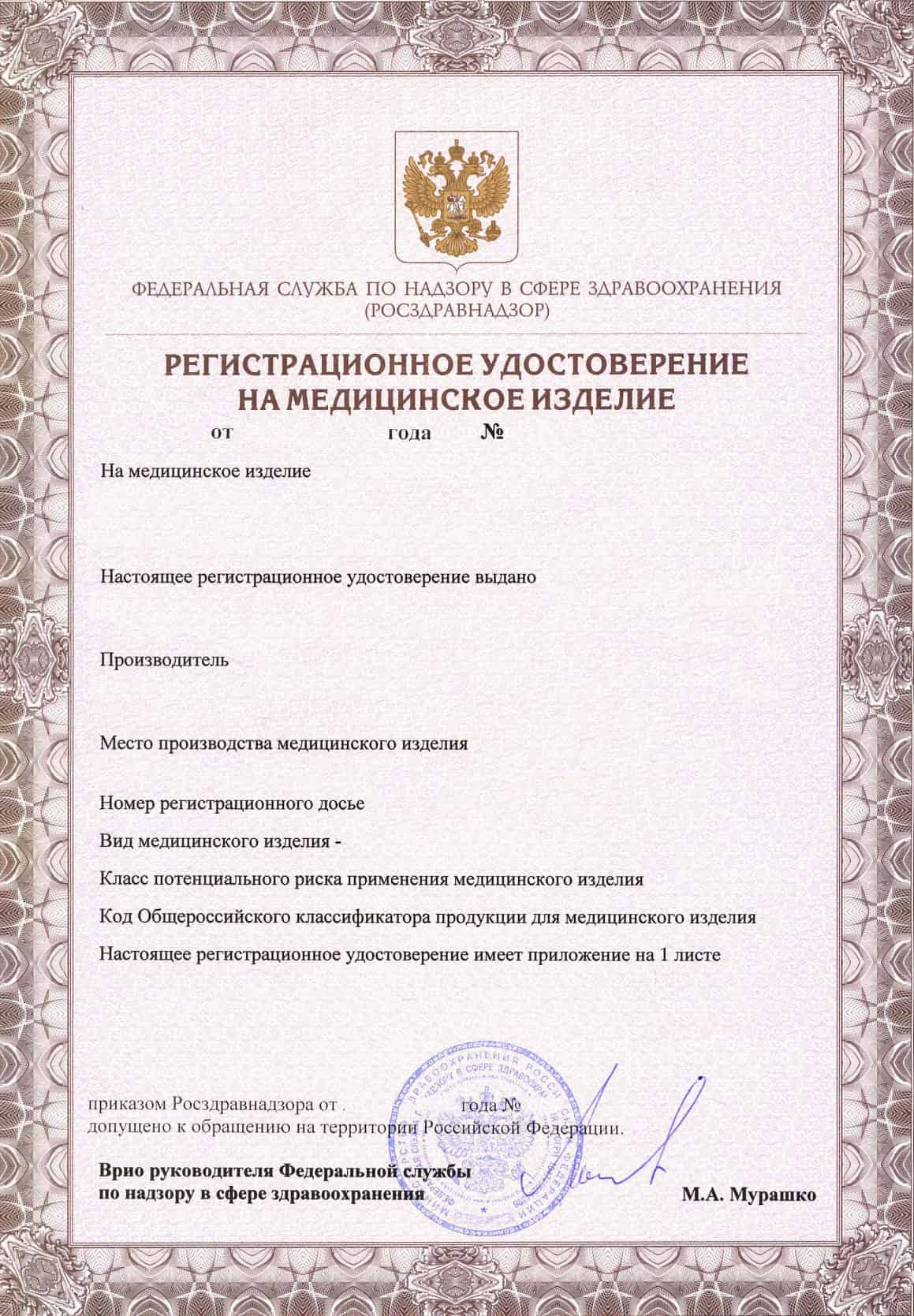
A registration certificate for medical devices is an official document issued by the Federal Service for Surveillance in Healthcare (Roszdravnadzor) confirming the state registration of the medical device. The registration certificate records key information about the product, the manufacturer, the applicant, the intended purpose, the product variants, and the core specifications.
The form of the registration certificate and the scope of information it contains are established by Roszdravnadzor Order No. 40-Pr/13 dated 16 October 2013.It is important to understand the difference between the registration routes. For circulation in Russia, the national procedure applies, while access to the common EAEU market is governed by a separate procedure under the Customs Union rules. In practice, the choice of route affects the supporting evidence, the format of certain documents, and the logic of the expert review process, so it must be determined correctly at the very beginning of the project.
Contents of the Article
- What Is a Medical Device
- Circulation of medical devices Without a Roszdravnadzor Registration Certificate
- What Exactly Is Registered: Name, Intended Purpose, Product Variants, and Configuration
- Potential Risk Classes for Registrable Medical Devices
- Documents Required for the Registration of medical devices with Roszdravnadzor
- Testing and Supporting Evidence
- Clinical Evaluation and Clinical Trials
- Stages of Registration of medical devices with Roszdravnadzor
- Timeframes for Registration of medical devices with Roszdravnadzor
- Cost and Cost Structure in Medical Device Registration
- State Fee for the Registration of medical devices
- Service Payment Stages for the Registration of medical devices with Roszdravnadzor
- Verification of the Registration Certificate in the Roszdravnadzor Register
- Advantages of CIRMI and Comparison with Other Market Providers
- Frequently Asked Questions on Medical Device Registration
1. What Is a Medical DeviceAccording to Article 38 of Federal Law No. 323-FZ, medical devices include instruments, apparatuses, equipment, materials, and other products intended for medical purposes, whether used separately or in combination, including accessories and dedicated software. The same article also states that medical devices are classified by potential risk class and by type under the nomenclature classification.
In other words, if medical devices are intended for prevention, diagnosis, treatment, rehabilitation, condition monitoring, medical research, or other medical purposes, and their principal effect is not achieved through pharmacological or immunological action, then they fall within the scope of medical device regulation and registration becomes the key issue.2. Circulation of medical devices Without a Registration CertificateIn Russia, the circulation and sale of medical devices are strictly regulated: only products that have undergone state registration in the prescribed manner, as well as products registered under the EAEU rules, are permitted.
Violations in the field of medical device circulation may result in administrative liability. Depending on the situation, this may include, among other things, Article 6.28 of the Administrative Offences Code of the Russian Federation and Article 6.33 of the same Code. In cases involving criminally punishable conduct, Article 238.1 of the Criminal Code of the Russian Federation applies.
In practice, risks arise not only from direct sales. They also arise when supplying products to medical institutions, participating in procurement, and placing products in sales channels where verification of the registration certificate is a standard compliance procedure. That is why proper registration of medical devices is not a formality, but a legal foundation for business.3. What Exactly Is Registered: Name, Intended Purpose, Product Variants, and ConfigurationOne of the key issues in the registration of medical devices is the correct determination of the registration object. From an expert review perspective, what matters is not attractive wording, but the internal consistency of the entire registration dossier.
- Name of the medical device. It must fully match across the application, technical description, instructions for use, labeling, packaging, operating documentation, and test reports. Any discrepancies in wording, even minor ones, may raise questions during the expert review and require additional document alignment.
- Intended purpose and field of use. The wording must accurately reflect the actual medical use of the product, the conditions of use, the target user group, and must be supported by the document package, testing, and evidentiary materials. The more precise and logical the intended purpose is defined, the lower the risk of unnecessary questions, clarifications, and additional requests during registration.
- Product variants. These include modifications, sizes, configurations, manufacturing materials, technical and functional characteristics, design features, packaging, sterility, shelf life, and other distinguishing features that the manufacturer intends to include within one registration object. Such information must be described consistently and without internal contradictions.
- Configuration and accessories. It is necessary to clearly define the supply set, specify what is included in the medical device package, what qualifies as accessories, and what is supplied separately. This information must be reflected identically and without discrepancies in the description, labeling, instructions for use, technical documentation, and test reports.
4. Potential Risk ClassesThe potential risk class is a classification value used to categorize medical devices by level of risk and affects the scope of the supporting evidence and the requirements for specific stages of the procedure. In registration practice, four classes are distinguished: 1, 2a, 2b, and 3.
A medical device may have only one risk class. If a device consists of several components with different classes, the device is assigned the highest class among those components.
5. Documents Required for the Registration of medical devices with RoszdravnadzorTo launch a registration project for medical devices with Roszdravnadzor, a minimum set of initial information is usually required. The full package of documents is prepared in stages: some materials are prepared before testing, some after testing, and some are clarified based on the results of the completed test reports.6. Testing and Supporting EvidenceTesting and other supporting studies are one of the central elements of the state registration of medical devices with Roszdravnadzor. These studies form the supporting evidence, confirming that the product complies with the established safety, quality, and effectiveness requirements within its declared intended purpose, conditions of use, and claimed specifications. For this reason, the testing block is not regarded as a mere formality, but as a mandatory part of the registration project, the quality of which directly affects the overall stability of the procedure.
The following are most commonly carried out within a project:Technical testing. These tests are aimed at confirming the functional, design, and operational characteristics of the device. Depending on the type of device, they may assess functionality, accuracy, strength, tightness, parameter stability, connection reliability, correct operating modes, resistance to external factors, and other indicators relevant to the declared intended purpose.
Toxicological studies and biological safety assessment of materials. Such studies are especially important for devices that come into contact with the human body, mucous membranes, wound surfaces, blood, tissues, or other biological media. Their purpose is to confirm that the materials of the device are safe for the intended method of use.
Testing related to sterility, packaging, and shelf life. Where applicable, these tests verify sterility parameters, sterile barrier stability, packaging properties, product integrity throughout the stated storage period, as well as validation of sterilization processes and confirmation of the claimed shelf life.
Clinical evaluation and other forms of effectiveness confirmation. Depending on the type of medical device, its potential risk class, and the specifics of its use, this may require an analysis of clinical data, scientific literature, practical use data, information on analogous or equivalent devices, and, where required, clinical trials.
Special and additional studies. Their scope is determined individually, depending on the design, principle of operation, materials, presence of software, measuring functions, energy sources, patient contact characteristics, operating conditions, and other features of the specific product.
The key principle is that the results of tests and studies must confirm the exact properties, parameters, and characteristics declared in the technical, operating, and registration documentation for the medical device being registered. In addition, the supporting evidence must relate specifically to the product variants, configurations, and modifications that are intended to be included in the state registration object. Any discrepancy between the documentation and the test results, in practice, increases the risk of additional requests, revisions, and longer project timelines.
7. Clinical Evaluation and Clinical TrialsThe clinical part depends on the risk class, the intended purpose of the medical device, its novelty, and the amount of evidence required for registration. If the product already has registered analogues and its characteristics can reasonably be compared with them, the issue is usually resolved through clinical evaluation. In such cases, scientific publications, manufacturer data, and information on analogous products are analyzed, and comparative materials are prepared.
CIRMI provides full support at this stage: it helps select the proper clinical confirmation format, interacts with the expert clinical organization, and participates in the preparation of justifications, comparative tables, and documentation required for the clinical evaluation.
If the product is new, has no analogue, or lacks sufficient supporting data, a full clinical trial involving human subjects is required in accordance with the established procedure. In practice, it is important to determine the approach to the clinical block in advance, because it affects both the document package and the registration timeline, as well as the overall stability of the procedure.
8. Stages of Registration of medical devicesThe stages of registration of medical devices with Roszdravnadzor are as follows:
- We analyze the initial documentation and clarify the intended purpose, product variants, and configuration. At the start, experts review the initial materials for the medical device, check the description, instructions for use, labeling, packaging, technical specifications, and the composition of the product variants. At this stage, it is important to eliminate contradictions in the documents, clarify exactly what will be included in the registration object, and build the project on a correct legal and technical basis. This approach helps reduce the risk of unnecessary requests and revisions even before testing begins.
- We determine the risk class and develop the registration strategy. The product is assessed under the medical device classification rules, after which the potential risk class is determined based on the design, intended purpose, conditions of use, degree of contact with the body, and other relevant features. At the same time, the overall registration strategy is formed: the mandatory stages, the composition of the supporting evidence, the logic of the clinical part, and the list of documents required to obtain the registration certificate are defined.
- We organize the testing and support the issuance of test reports. After the registration route is selected, the necessary types of testing are determined, technical assignments are prepared, the scope of testing is agreed upon, and interaction with test centers is organized. The goal of this stage is not just to conduct the tests, but to ensure that the final reports correspond to the characteristics of the device, its intended purpose, its product variants, and are suitable for the subsequent state registration of the medical device.
- We compile the registration dossier in a logical format expected by the expert review. The documents are assembled into a single system where all information is aligned both in substance and in wording. It is checked that the device name, intended purpose, configuration, characteristics, labeling, instructions, and test results do not contradict each other and do not create unnecessary questions for the expert review. It is at this stage that the foundation is laid for how smoothly the registration of medical devices and the obtaining the Roszdravnadzor registration certificate will proceed.
- We submit the documents and support the expert review, preparing responses to requests from the registration authority. Once the dossier is prepared, the project is supported through the document submission and review stage. If requests are received during the expert review, specialists analyze them, prepare responses, revise materials where necessary, and coordinate the elimination of comments. This working format helps keep the process under control and prevents the procedure from being delayed without objective reasons.
- We obtain the decision and complete the registration certificate issuance. The final stage is bringing the project to a successful outcome. The expert team supports the procedure through to the issuance of the registration certificate, including the registry entry for medical devices, and monitors the accuracy of the final information entered into the registration documents. As a result, the applicant receives an official document confirming the lawful circulation of the medical device in the territory of the Russian Federation or the EAEU countries.
For convenience, you may refer to the visual registration flowchart for medical devices, which step by step shows the overall logic of the procedure, the scope of the main work, and the sequence of key actions within the project.9. Timeframes for Registration of medical devices with RoszdravnadzorThe time required for registration of medical devices with Roszdravnadzor depends on the readiness of the initial documentation, the number of product variants, the scope of testing, the clinical part, and the speed of approvals on the part of the manufacturer and the applicant. In practice, registration of medical devices with Roszdravnadzor proceeds faster when the registration object, the intended purpose of the device, the configuration, the materials, and the logic of the supporting evidence are correctly defined from the outset. If these issues are worked out in advance, the project usually moves more smoothly and the risk of additional requests from the expert review is significantly lower.
Based on the experience of CIRMI s expert team, the average project timeline for obtaining a Roszdravnadzor registration certificate for medical devices is usually around 6 to 7 months. At the same time, for more complex projects, including Class 3 devices, as well as where there is a lack of initial data, a need to revise technical and operating documentation, an extended testing scope, or a complex clinical part, the registration timeline may increase and in some cases reach up to 12 months.
The timeline is also affected by how quickly the manufacturer or applicant provides missing materials, agrees on wording, confirms the product variants, and makes corrections to the documents. Therefore, when the goal is to obtain a Roszdravnadzor registration certificate for medical devices within reasonable and predictable timeframes, the main focus is always placed not on formal acceleration of the procedure, but on high-quality project preparation. The better the documentation is compiled and the more accurately the registration strategy is chosen, the higher the likelihood of completing the procedure without unnecessary revisions and lengthy delays.
10. Cost and Cost StructureThe total cost of medical device registration usually consists of several blocks: the state fee, testing and laboratory services, the clinical part, translations and notarization, as well as registration support services and the development or revision of documentation.
11. State Fee for Medical Device RegistrationThe state fee amounts for the registration of medical devices with Roszdravnadzor are established by Article 333.32.2 of the Tax Code of the Russian Federation.
12. Service Payment Stages for Registration Support of medical devices with RoszdravnadzorThe registration of medical devices is a staged project, so for convenience in financial planning, payment is usually divided into several parts. This approach allows the client not to pay the full amount at once, but to link payments to clear and tangible work results.
As a rule, settlements are structured as follows: the first part is paid after the project is launched and the analysis of the initial documentation begins, the second after the document package for the medical device has been prepared and approved, the next at the stage of organizing and conducting testing, and the final part after the registration certificate has been obtained and the project has been completed. The exact number of stages and the amount of each part may vary depending on the complexity of the device, the scope of work, and the selected registration route, but the principle itself remains the same: payment is made as the project progresses and key milestones are reached. This format makes the budget more transparent, understandable, and convenient for planning, and the payment terms are fixed in the contract in advance.
13. Verification of the Registration Certificate in the Roszdravnadzor RegisterInformation on registered medical devices is published in the state register maintained by Roszdravnadzor. Verification of a registration certificate is usually carried out by the certificate number, product name, manufacturer, applicant, and other identifying parameters. This makes it possible to quickly confirm that the product has indeed undergone state registration and is lawfully allowed to circulate. In practice, register verification is especially important before product supply, participation in procurement, conclusion of contracts, internal quality control, and the start of work with distributors or medical organizations. In essence, this is a simple and convenient tool that helps confirm the product s status, compare the core registration details, and reduce risks during commercial and legal due diligence.
14. Why Companies Choose CIRMIThere are many service providers in the medical device registration market, but for the client the difference usually shows itself not in presentations or polished promises. It appears elsewhere: either the project moves along a clear route, or it turns into a drawn-out story with requests, rework, timeline shifts, and budget growth. Below is why this happens in practice.
15. Frequently Asked Questions on Medical Device RegistrationCan a product be registered without toxicological testing?
In some cases, this is possible, but only after a proper analysis of the specific product, its materials, design, intended purpose, and the nature of its contact with the human body. Most often, the question of whether toxicological testing can be waived arises for products that do not come into contact with the patient s body at all, or that make contact in such a way that the material-related risk can reasonably be assessed by other means. There is no universal rule here: the decision is always made not based on the device name, but on the combination of characteristics and the supporting evidence. In our work, we try not to inflate the client s budget unnecessarily and not to include unnecessary studies where they are objectively not required. That is why we first analyze the project on its merits, then select the optimal testing scope, and only after that build the registration route. In addition, we usually recommend laboratories that offer a reasonable balance of cost, timing, and report quality.
Which medical devices require registration and which do not?
The general rule is simple: if a product is positioned as a medical device for its intended purpose and is intended for lawful circulation on the market, it will generally require state registration. However, there are exceptions to this rule, and these are precisely what most often create confusion. For example, registration is usually not required for products manufactured on the basis of an individual order for a specific patient and intended exclusively for that patient s personal use according to individual parameters. In addition, in each project it is important to look not only at the device name, but also at its actual intended purpose, manufacturing method, user group, supply format, and how the product is positioned in the documentation and labeling. In practice, we always recommend starting with a legal and technical review, because a mistake at the beginning can lead either to unnecessary costs or to the project being sent down the wrong route.
Who may act as the applicant for medical device registration in Russia?
The applicant for state registration of a medical device may be either the manufacturer itself or its authorized representative. If the manufacturer is Russian, the applicant is usually the manufacturer itself. If the manufacturer is foreign, the Russian registration procedure usually involves an authorized representative located in the Russian Federation and acting on the basis of a power of attorney and other supporting documents. In practice, it is important not just to formally indicate the required party, but to build the legal structure correctly, because the applicant s status affects the composition of the registration dossier, the list of supporting documents, and the circulation of the device after the registration certificate has been obtained. An error in selecting the applicant or in documenting its authority can create problems already at the expert review stage and sometimes even after registration is completed, when the device is placed on the market and begins to be supplied to customers.
What do medical device registration timelines in Russia actually depend on?
Registration timelines do not depend on just one factor, but on a whole set of circumstances. They are influenced by the readiness of the initial documentation, the correctness of the selected registration route, the number of product variants, the scope of required testing, the clinical part, and the speed of approvals on the part of the manufacturer and the applicant. A great deal also depends on how carefully the project is structured at the start. If the documents contain contradictions, vague intended use, inconsistencies in configuration, or an incorrectly determined risk class, the procedure almost always begins to slow down because of deficiency letters and revisions. That is why the main way to genuinely reduce timelines is not to rush the expert review, but to build the project correctly before submission. When the registration object, supporting evidence, dossier structure, and testing logic are defined accurately, registration usually proceeds much more smoothly, faster, and more predictably for all parties involved.
Does the risk class affect the project cost and scope of work?
Yes, it affects them directly, and it should not be underestimated. The potential risk class of a medical device determines not only its formal category in the documentation, but also the actual scope of registration work. It affects the depth of project analysis, the composition of the supporting evidence, the list of required tests, the clinical part, and the amount of the state fee for the expert review. As a rule, the higher the risk class, the more demanding the requirements for supporting materials and the more closely the expert review focuses on safety, effectiveness, and quality. That is why an error in determining the risk class at the start is almost always expensive: the registration strategy has to be reconsidered, the supporting evidence expanded, and in some cases certain stages have to be repeated, resulting in lost time. We do not treat the risk class as a mere formality, but as one of the key project parameters that determines the entire further registration logic, the budget, and the overall scope of support.
Obtaining a Roszdravnadzor Registration Certificate for medical devices
Registration of medical devices with Roszdravnadzor is a state procedure that medical devices are granted the legal right to circulate in the territory of the Russian Federation. In essence, this is the main legal filter confirming that the device may be lawfully placed on the market, supplied, used in procurement, listed on marketplaces, and used in clinical practice for its intended purpose.
A registration certificate for medical devices is an official document issued by the Federal Service for Surveillance in Healthcare (Roszdravnadzor) confirming the fact of state registration of the medical device. The registration certificate records key information about the device, the manufacturer, the applicant, the intended purpose, product variants, and basic characteristics.
It is important to understand the difference between registration routes. For circulation in Russia, the national procedure applies, while entry into the common EAEU market is governed by a separate procedure under the Customs Union rules. In practice, the choice of route affects the supporting evidence, the format of certain documents, and the logic of expert review, so it is important to determine it correctly at the very beginning of the project.
- What is a medical device
- Circulation of medical devices without a Roszdravnadzor registration certificate
- What exactly is registered: name, intended purpose, versions, configuration
- Potential risk classes for the registered medical devices
- Documents required for registration of medical devices with Roszdravnadzor
- Testing and supporting evidence
- Clinical evaluation and clinical trials
- Stages of registration of medical devices with Roszdravnadzor
- Timeframes for registration of medical devices with Roszdravnadzor
- Cost and cost structure in medical device registration
- State fee for registration of medical devices
- Stages of payment for medical device registration support services with Roszdravnadzor
- Verification of the registration certificate in the Roszdravnadzor register
- Advantages of CIRMI and comparison with other market providers
- Frequently asked questions about medical device registration
According to Article 38 of Federal Law No. 323-FZ, medical devices include instruments, apparatus, equipment, materials, and other products used for medical purposes either separately or in combination with each other, including accessories and dedicated software. The same article also establishes that medical devices are divided into classes depending on the potential application risk and into types according to the nomenclature classification.
In Russia, the circulation and sale of medical devices are strictly regulated: only those devices that have undergone state registration in the established manner, as well as devices registered under the EAEU rules, are allowed on the market.
Administrative liability is for violations in the circulation of medical devices. Depending on the situation, this may include, in particular, Article 6.28 of the Administrative Offenses Code of the Russian Federation and Article 6.33 of the Administrative Offenses Code of the Russian Federation. In cases involving criminal offenses, Article 238.1 of the Criminal Code of the Russian Federation applies.
One of the key points in the registration of medical devices is to correctly define the registration object. From the standpoint of expert review, what matters is not attractive wording but the consistency of the entire logic within the registration dossier.
- Name of the medical device. It must fully match across the application, technical description, instructions for use, labeling, packaging, operating documentation, and test reports. Any discrepancies in wording, even minor ones, may raise questions during expert review and require additional coordination of documents.
- Intended purpose and field of application. The wording must accurately reflect the actual medical use of the device, the conditions of use, the target user group, and be supported by the document package, testing, and supporting evidence. The more precise and logical the intended purpose is defined, the lower the risk of unnecessary questions, clarifications, and additional requests during registration.
- Versions. These include modifications, sizes, configurations, materials, technical and functional characteristics, design features, packaging, sterility, shelf life, and other distinguishing features that the manufacturer intends to include within a single registration object. Such information must be described consistently and without internal contradictions.
- Configuration and accessories. It is necessary to clearly define the contents of supply, specify what is included in the medical device kit, what is considered an accessory, and what is supplied separately. This information must be reflected consistently and without discrepancies in the description, labeling, instructions for use, technical documentation, and test reports.
The potential risk class is a conventional value used to classify medical devices by degree of risk and affects the scope of the supporting evidence and the requirements applicable to specific stages of the procedure. In registration practice, four classes are distinguished: 1, 2a, 2b, and 3.
A medical device may have only one risk class. If the device consists of several components with different classes, the device is assigned the highest class among its components.
Testing and other confirmatory studies are one of the central elements of state registration of medical devices with Roszdravnadzor. It is on their basis that the supporting evidence is formed, confirming that the device meets the established safety, quality, and effectiveness requirements within its declared intended purpose, conditions of use, and stated characteristics. For this reason, the testing block is viewed not as a formality but as a mandatory part of the registration project, the quality of which directly affects the robustness of the entire procedure.
Technical testing. It is aimed at confirming the functional, design, and operational characteristics of the device. Depending on its type, the assessment may cover operability, accuracy, strength, tightness, parameter stability, connection reliability, correctness of operating modes, resistance to external influences, and other indicators relevant to the declared intended purpose.
Toxicological studies and biological safety evaluation of materials. Such studies are especially important for devices that come into contact with the human body, mucous membranes, wound surfaces, blood, tissues, or other biological media. Their purpose is to confirm that the materials of the device are safe for the intended method of use.
Testing related to sterility, packaging, and shelf life. Where applicable, this includes assessment of sterility parameters, stability of the sterile barrier, packaging properties, preservation of the device during the declared storage period, as well as validation of sterilization processes and confirmation of the declared shelf life.
Clinical evaluation and other forms of confirming effectiveness. Depending on the type of medical device, its potential risk class, and the specifics of its use, this may require analysis of clinical data, scientific literature, practical use information, data on analogous or equivalent devices, and, where required, clinical trials.
The key principle is that the results of testing and studies must confirm exactly those properties, parameters, and characteristics that are declared in the technical, operating, and registration documentation for the medical device being registered. In addition, the supporting evidence must relate specifically to the product variants, configurations, and modifications intended to be included in the state registration object. Any discrepancy between the documentation and the test results in practice increases the risk of additional requests, revisions, and longer project timelines.
The clinical part depends on the risk class, the intended purpose of the medical device, its novelty, and the amount of evidence required for registration. If the device already has registered analogues and its characteristics can be reasonably compared with them, the issue is usually resolved through clinical evaluation. In such cases, scientific publications, manufacturer data, and information on analogous devices are analyzed, and comparative materials are prepared.
CIRMI provides full support at this stage: it helps choose the correct format for clinical confirmation, interacts with the expert clinical organization, and participates in preparing justifications, comparison tables, and documents required for the clinical evaluation process.
If the device is new, has no analogue, or there is insufficient supporting data for it, a full clinical trial involving human participants is required in accordance with the established procedure. In practice, it is important to determine the approach to the clinical part in advance, because this affects both the set of required documents and the registration timeline, as well as the overall robustness of the procedure.
- We analyze the initial documentation and clarify the intended purpose, product variants, and configuration. At the start, experts review the initial materials for the medical device, check the description, instructions for use, labeling, packaging, technical characteristics, and the composition of product variants. At this stage, it is important to remove contradictions in the documentation immediately, clarify exactly what will be included in the registration object, and structure the project on a correct legal and technical basis. This approach makes it possible to reduce the risk of unnecessary requests and revisions even before testing begins.
- We determine the risk class and develop the registration strategy. The device is assessed according to the medical device classification rules, after which the potential risk class is determined taking into account the design, intended purpose, conditions of use, degree of contact with the body, and other relevant characteristics. At the same time, the overall registration strategy is formed: the mandatory stages, the composition of the supporting evidence, the logic of the clinical part, and the list of documents required to obtain the registration certificate are defined.
- We organize testing and support the receipt of test reports. After the registration route has been selected, the required types of testing are determined, technical assignments are prepared, the scope of assessments is agreed upon, and cooperation with testing centers is organized. The purpose of this stage is not merely to conduct testing, but to ensure that the final reports correspond to the device characteristics, its intended purpose, product variants, and are suitable for the subsequent state registration of the medical device.
- We compile the registration dossier in a logical format expected by expert review. The documents are assembled into a unified system in which all information is aligned in meaning and wording. It is verified that the device name, intended purpose, configuration, characteristics, labeling, instructions, and test results do not contradict each other or create unnecessary questions during expert review. It is precisely at this stage that the foundation is laid for how smoothly the registration of medical devices and the obtaining the Roszdravnadzor registration certificate will proceed.
- We submit the documents and support the expert review, preparing responses to requests from the regulatory authority. After the dossier has been prepared, the project is supported during the submission and review stage. If requests are received during expert review, specialists analyze them, prepare responses, revise the materials where necessary, and coordinate the elimination of comments. This format of work helps keep the process under control and avoids delays in the procedure without objective reasons.
- We obtain the decision and formalize the registration certificate. The final stage consists of bringing the project to a positive result. The expert department supports the procedure until the registration certificate is issued for medical devices or the registry entry is made, and monitors the correctness of the final information entered into the registration documents. As a result, the applicant receives an official document confirming the lawful circulation of the medical device in the territory of the Russian Federation or the EAEU countries.
The timeframes for registration of medical devices with Roszdravnadzor depend on the readiness of the initial documentation, the number of product variants, the scope of testing, the clinical part, and the speed of approvals by the manufacturer and the applicant. In practice, registration of medical devices with Roszdravnadzor proceeds faster when the registration object, the intended purpose of the device, the configuration, materials, and the logic of the supporting evidence are correctly defined from the very start. If these issues are worked through in advance, the project usually progresses more smoothly, and the risk of additional requests from expert review is noticeably lower.
According to the experience of CIRMI s expert department, the average project timeline within which a Roszdravnadzor registration certificate for medical devices is obtained is usually around 6 to 7 months. At the same time, for more complex projects, including Class 3 devices, as well as where there is a lack of initial data, a need to revise technical and operating documentation, an expanded scope of testing, or a complex clinical part, the registration timeline may increase and in some cases reach 12 months.
The timelines are also affected by how quickly the manufacturer or applicant provides missing materials, approves wording, confirms product variants, and incorporates revisions into the documentation. Therefore, when a Roszdravnadzor registration certificate for medical devices is required within reasonable and predictable timelines, the main emphasis is always placed not on formally accelerating the procedure, but on preparing the project properly. The better the documentation is assembled and the more accurately the registration strategy is chosen, the higher the probability of completing the procedure without unnecessary revisions and prolonged pauses.
The total cost of registration of medical devices usually consists of several blocks: the state fee, testing and laboratory services, the clinical part, translations and notarization, as well as services for registration support and for drafting or revising documentation.
The state fee amounts for registration of medical devices with Roszdravnadzor are established by Article 333.32.2 of the Tax Code of the Russian Federation.
Registration of medical devices is a staged project, so for the convenience of financial planning, payment is usually divided into several parts. This approach allows the customer to avoid paying the full amount at once and instead link payments to clear, tangible work results.
As a rule, the payment structure is organized as follows: the first part is paid after the project is launched and analysis of the initial documentation begins, the second after preparation and approval of the documentation package for the medical device, the next at the stage of organizing and conducting testing, and the final part after the registration certificate is obtained and the project is completed. The number of stages and the amount of each part may vary depending on the complexity of the device, the scope of work, and the selected registration route, but the principle itself remains unchanged: payment is made as the project progresses and key stages are completed. This format makes the budget more transparent, understandable, and convenient for planning, while the payment terms are fixed in advance in the contract.
Information on registered medical devices is published in the state register of Roszdravnadzor. Verification of the registration certificate is usually carried out by registration certificate number, device name, manufacturer, applicant, and other identifying parameters. This method allows one to quickly make sure that the device has indeed undergone state registration and is lawfully allowed for circulation in the established manner. In practice, verification in the register is especially important before product supply, participation in procurement, execution of contracts, internal quality control, and the beginning of work with distributors or medical organizations. In essence, this is a simple and convenient tool that helps confirm the status of the device, verify the main registration details, and reduce risks during commercial and legal due diligence.
There are many providers on the medical device registration market, but for the customer the difference is usually seen not in a polished presentation and not in promises. It shows up elsewhere: either the project moves along a clear route, or it turns into a drawn-out story with rework, postponed timelines, silence from the contractor, and a growing budget. The reasons why this happens in practice are shown below.
Can a device be registered without toxicological testing?
In certain cases this is possible, but only after a proper analysis of the specific device, its materials, design, intended purpose, and the nature of its contact with the human body. Most often, the question of whether toxicological testing may be omitted arises for devices that do not come into contact with the patient s body at all, or come into contact in such a way that the material-related risk can be reasonably assessed by other means. There is no universal rule here: the decision is always made not based on the device name, but on the combination of characteristics and the supporting evidence. In our work, we try not to inflate the client s budget unnecessarily and not to include extra studies where they are objectively not required. That is why we first analyze the project on its merits, then select the optimal testing scope, and only after that build the route. In addition, we usually recommend laboratories where cost, timelines, and report quality are combined in a sensible way.
Which medical devices require registration and which do not?
The general rule is simple: if a product is intended to be marketed as a medical device and is planned for lawful circulation on the market, state registration is generally required. However, there are exceptions to this rule, and these are exactly what most often cause confusion. For example, registration is usually not required for devices manufactured on the basis of an individual order for a specific patient and intended exclusively for that patient s personal use according to individual parameters. In addition, in every project it is important to look not only at the device name, but also at its actual intended purpose, manufacturing method, user group, supply format, and the way the device is positioned in its documentation and labeling. In practice, we always recommend starting with a legal and technical assessment, because an error at the beginning may lead either to unnecessary costs or to the project following the wrong route.
Who may act as the applicant for medical device registration in Russia?
The applicant for state registration of a medical device may be either the manufacturer itself or its authorized representative. If we are talking about a Russian manufacturer, the applicant is most often the manufacturer itself. If the manufacturer is foreign, the Russian registration procedure usually involves an authorized representative in the Russian Federation acting on the basis of a power of attorney and other supporting documents. In practice, it is important not merely to formally indicate the correct person, but to structure the entire legal framework properly, because the applicant s status affects both the composition of the registration dossier and the list of attached documents, as well as the circulation of the device after the registration certificate has been obtained. An error in selecting the applicant or in documenting its authority may create problems already at the expert review stage, and sometimes even after the registration has been completed, when the device is placed on the market and starts being supplied to customers.
What do medical device registration timelines in Russia actually depend on?
Registration timelines do not depend on just one factor, but on a whole set of circumstances. They are affected by the readiness of the initial documentation, the correctness of the selected registration route, the number of product variants, the scope of required testing, the clinical part, as well as the speed of approvals on the part of the manufacturer and the applicant. A great deal also depends on how carefully the project is assembled from the very beginning. If the documentation contains contradictions, vague intended purpose, inconsistencies in configuration, or an incorrectly selected risk class, the procedure almost always starts slowing down because of requests and revisions. That is why the main way to actually shorten timelines is not to rush expert review, but to build the project correctly before submission. When the registration object, supporting evidence, dossier structure, and testing logic are defined accurately, registration usually proceeds much more smoothly, faster, and more predictably for all project participants.
Does the risk class affect the project cost and scope of work?
Yes, it directly affects both, and this should definitely not be underestimated. The potential risk class of a medical device determines not only its formal category in the documentation, but also the actual scope of registration work. It affects the depth of project analysis, the composition of the supporting evidence, the list of required tests, the clinical part, and the amount of the state fee for expert review. As a rule, the higher the risk class, the greater the requirements for supporting materials and the more closely expert reviewers assess the safety, effectiveness, and quality of the device. That is why an error in determining the risk class at the start is almost always costly: the strategy has to be reconsidered, the supporting evidence has to be expanded, and sometimes certain stages have to be restarted, which leads to loss of time. We usually treat the risk class not as a formality, but as one of the key project parameters on which the entire further logic of registration, the budget, and the overall scope of support depend.
Get information about the registration conditions for your device
Send your request by email to Info@cirmi.ru, or use the form on the right.
We guarantee a detailed and accurate response to your request within 30 minutes!
Call us during business hours at our multi-line phone number +7 (495) 199-72-57
Our working hours are from 09:00 AM to 06:00 PM (Moscow time)
By sending a request to the expert department of the Center for Testing and Registration of Medical Devices (CIRMI LLC), you agree to the personal data processing terms.